 RummySlotsHub
How to Play Indian Rummy: 13-Card Rules, Sequences & Tricks to Win
Updated June 2026
Indian rummy looks complicated the first time you see 13 cards fanned out in your hand, but the game is really one simple idea repeated: keep picking and discarding cards until all 13 are organised into neat groups. Once that clicks, everything else — jokers, scoring, when to quit a hand — falls into place fast.
This is the no-jargon version of how to play 13-card rummy, the format every Indian rummy app uses. We will build it up piece by piece with clear examples, then finish with the habits that actually separate winners from everyone else at the table. By the end you will be ready to sit at a real table and hold your own.
The goal: what you are actually trying to do
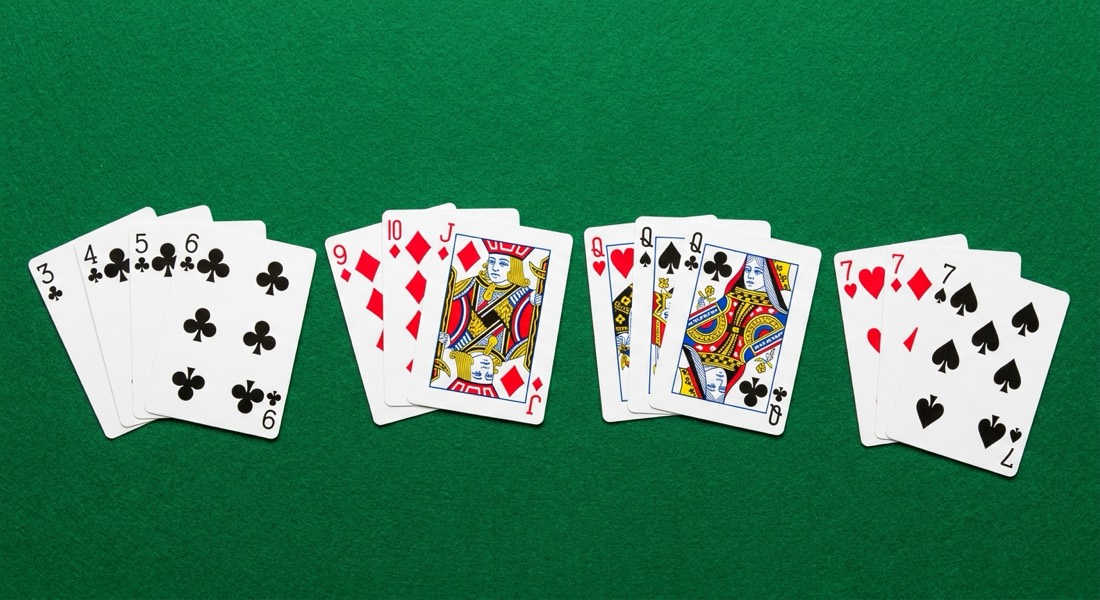
You are dealt 13 cards. To win, you arrange all 13 into valid groups — called sequences and sets — and then "declare" before your opponents do. The picture above is exactly what a finished, winning hand looks like.
There is one non-negotiable rule that trips up every beginner, so burn it in now: your hand must contain at least two sequences, and at least one of them must be a pure sequence (a run with no joker). Miss that, and your declaration is invalid no matter how tidy the rest of your hand looks.
How a round is played, turn by turn
After the deal, there are two piles in the middle: a face-down closed deck and a face-up open pile. On your turn you do two things — pick one card (from either pile) and then discard one card you don't need to the open pile. That's the whole loop.
One card is also flipped at the start to become the wild joker for that round (more on that below). You keep drawing and discarding, slowly shaping your 13 cards into sequences and sets, until someone completes their hand and declares.
Building block 1: the pure sequence
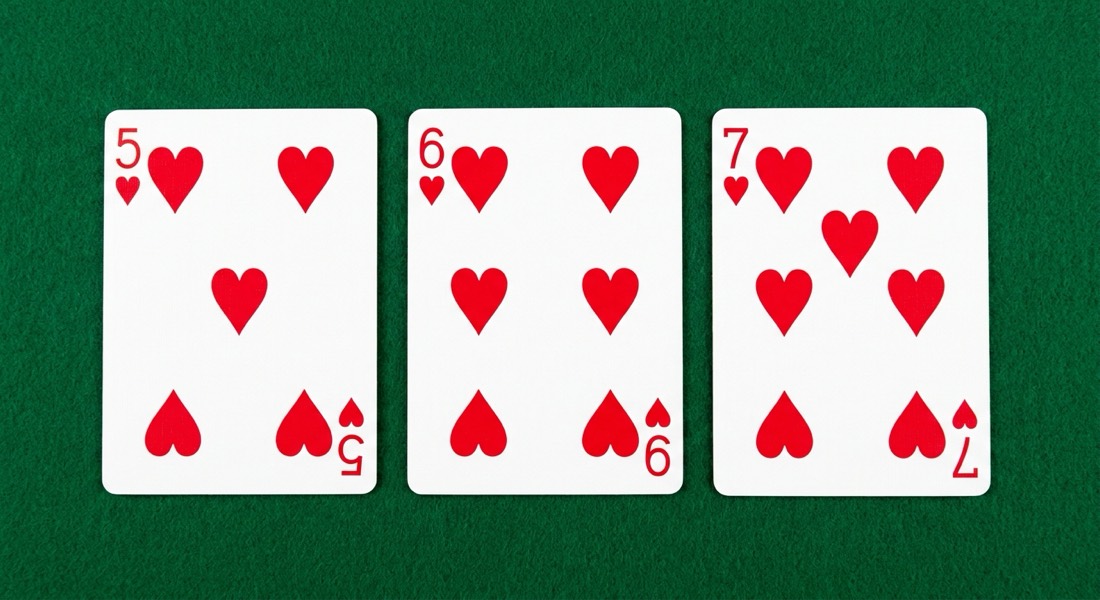
A sequence is three or more consecutive cards of the same suit. A pure sequence uses no joker at all — just clean, consecutive cards. This is the one group you absolutely must have, so it is always your first priority when sorting a fresh hand.
Here the 5, 6 and 7 of hearts form a perfect pure sequence. Ace can sit at either end (A-2-3 or Q-K-A), but it cannot wrap around (K-A-2 is not allowed).
Building block 2: the impure sequence
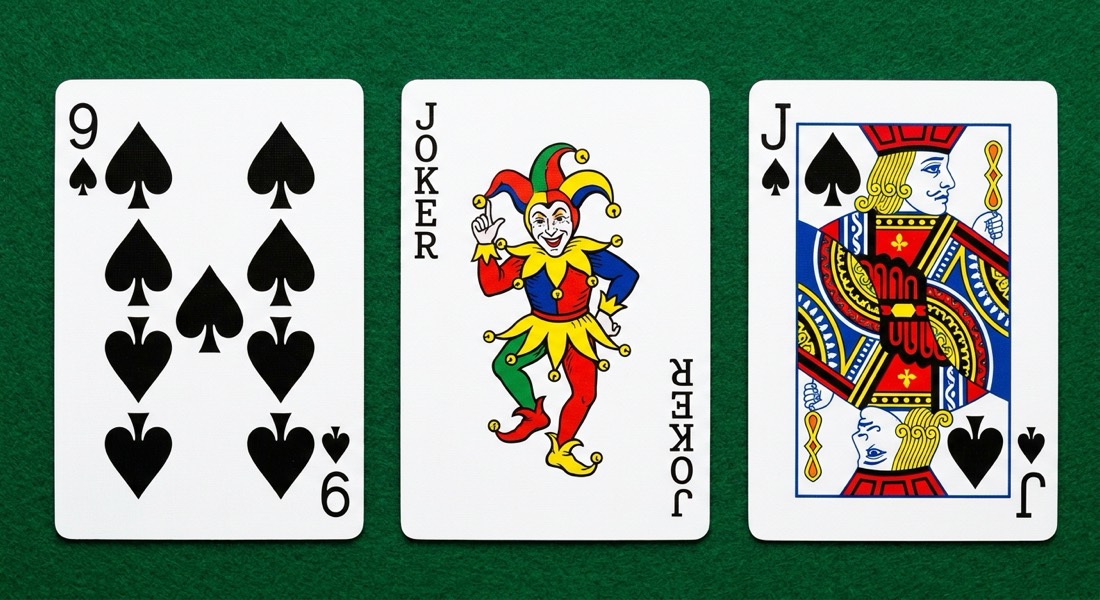
An impure sequence is also a run of the same suit, but it uses a joker to fill a gap. It is your safety net: when you are missing one card to complete a run, a joker steps in and finishes the job.
Below, the 9 and Jack of spades are missing the 10 of spades — so a joker takes that spot. The group still counts as a valid sequence, just not a pure one.
Building block 3: sets
A set is three or four cards of the same rank but different suits. Once your two sequences are safe, your remaining cards go into sets to complete the hand.
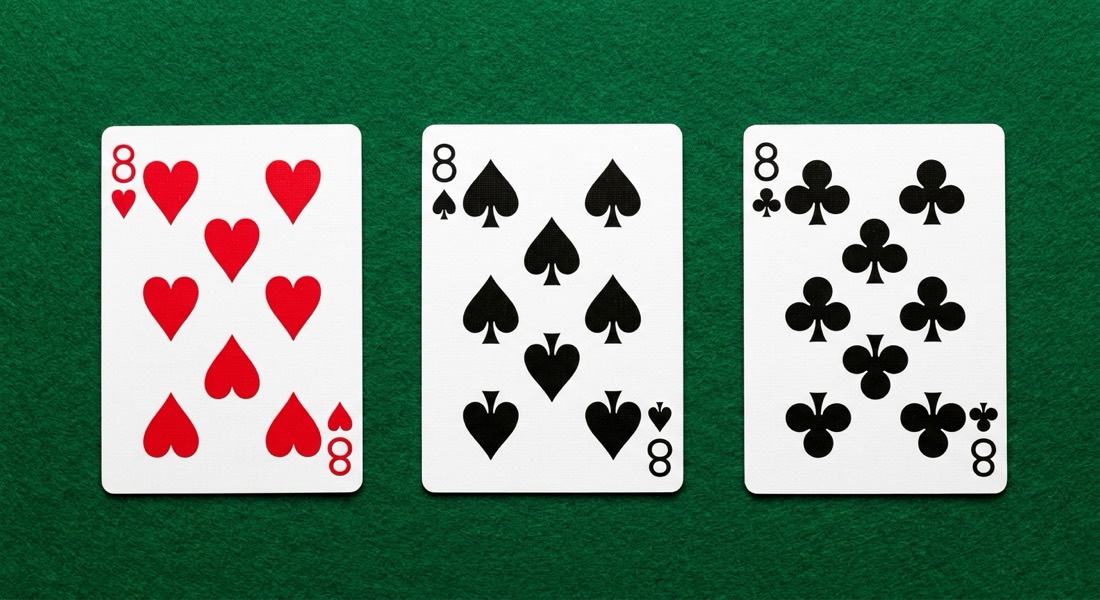
These three eights — hearts, spades and clubs — make a clean set. You can use a joker in a set too, but you can never repeat the same suit (two eights of hearts is not a valid set).
How jokers work
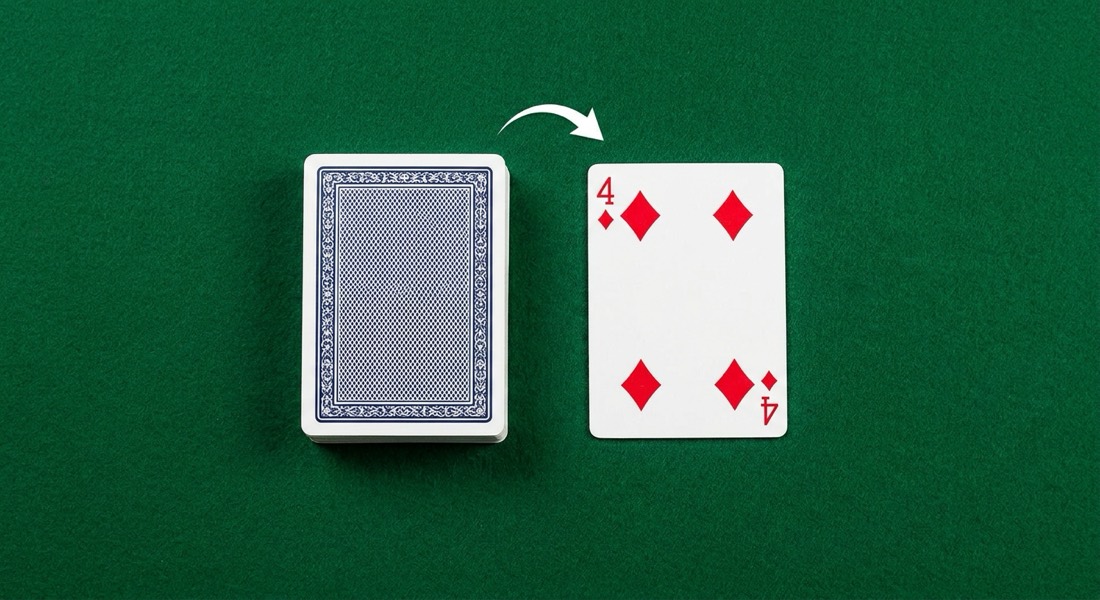
Jokers are the great equalizer in rummy. There are two kinds: the printed joker that comes in the deck, and the wild joker — a random card flipped at the start of the round, where every card of that rank becomes a joker for everyone.
In the example below, the 4 of diamonds has been turned up, so all four 4s now act as jokers this round. Use jokers to complete impure sequences and sets — but never in your one required pure sequence, and remember a joker is worth zero points, which makes it doubly valuable to hold.
Scoring: how points work
Rummy is a game of lowest score, not highest. When someone declares a valid hand, they score zero — the perfect result. Everyone else scores points for the cards they failed to arrange, and points are bad.
Number cards are worth their face value, while the Ace, King, Queen and Jack are each worth 10. Jokers are worth zero. A wrong declaration costs a flat 80-point penalty, and in points rummy you can also choose to "drop" a weak hand early for a small penalty (often 20) instead of risking a big loss. Across most apps, your per-game loss is capped at 80 points.
Tricks the best rummy players actually use
Knowing the rules makes you a player; these habits make you a winner. None of them are secrets — they are just the things good players do automatically and beginners forget under pressure.
- Form your pure sequence first, always. Until you have it, you cannot win — so every early turn should serve that one goal.
- Hold jokers for sequences and high-value gaps, not low cards. A joker turning a 9-10-Q into a run is far better than wasting it on a pair of threes.
- Discard your high cards (K, Q, J, A) early if they aren't connecting. If you get caught with them at the end, they cost 10 points each.
- Watch what opponents pick from the open pile — it tells you exactly which sequences and sets they are chasing, so you can stop feeding them.
- Learn to drop. A bad hand you drop for 20 points beats stubbornly playing it to a full 80-point loss. Discipline, not luck, is what compounds.
- Keep a card or two that work in more than one combination, so a single useful draw can complete a group two different ways.
Practice for free, then play for real cash
Every rummy app lets you practice on free tables before you ever touch real money — use them until forming sequences feels automatic. Beginner-friendly apps like OK Rummy, ABC Rummy and Hello Rummy keep things simple, while popular options such as Rummy 91 and Gogo Rummy have plenty of low-entry cash tables when you are ready.
When you do step up to cash games, you can start without risking your own money — see our list of rummy apps with a ₹51 signup bonus to grab a free welcome bonus first.
 Rummy 91rummy 91 · ₹51
 Gogo Rummygogo rummy · ₹51
 OK Rummyok rummy · ₹51
 ABC Rummyabc rummy · ₹51
 Top Rummytop rummy · ₹51
 Hello Rummyhello rummy · ₹51
Frequently Asked Questions
How many cards are in Indian rummy?
Each player is dealt 13 cards in Indian rummy. Your goal is to arrange all 13 into valid sequences and sets, including at least two sequences with one pure sequence, and then declare.
What is the difference between a pure and impure sequence?
A pure sequence is a run of three or more consecutive cards of the same suit with no joker. An impure sequence is the same kind of run but uses a joker to fill in a missing card. You must have at least one pure sequence to win.
Can I win rummy without a pure sequence?
No. A valid declaration requires at least two sequences, and at least one of them must be pure. Without a pure sequence your hand is invalid, even if every other group is complete, and you take an 80-point penalty.
How are points counted in rummy?
The winner scores zero. Everyone else scores the value of their unarranged cards — number cards at face value, and Ace, King, Queen and Jack at 10 each. Jokers count as zero. Lower is better, and most apps cap a single game's loss at 80 points.
What is the best trick to win rummy?
Form your pure sequence first and learn to drop bad hands early. Beginners lose most by chasing hopeless hands; disciplined players cut their losses and let small, consistent wins add up over many games.
Is Indian rummy a game of skill or luck?
Indian courts treat rummy as a game of skill, because long-term results depend on decisions — which cards to hold, discard and when to drop — far more than the deal you are given. That is also why real-cash rummy is legal across most of India.